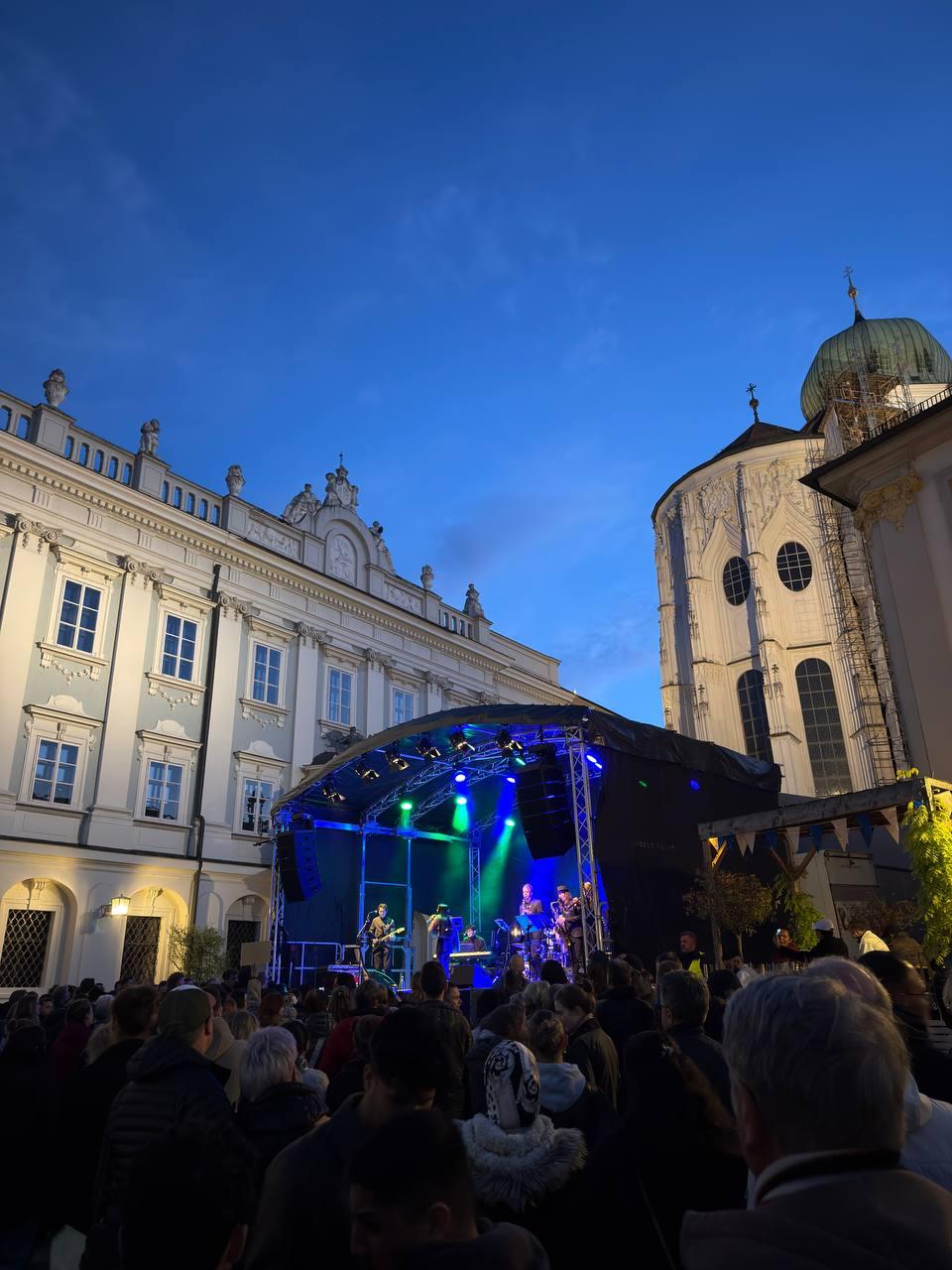
The story behind Passau’s “Night of Music” is one of community renewal, historical pride, and smart urban planning. Although it feels like an age-old tradition because it takes place among centuries‑old architecture, the festival is actually a relatively young cultural initiative.
1. A modern initiative for a historic city 🏛️
The festival was created by the City of Passau and its cultural committee under the leadership of Mayor Jürgen Dupper. The goal was simple but ambitious: to fully revitalize the historic old town (Altstadt) after the quiet winter months and to create a hyper‑local, community‑driven event that costs visitors nothing. By opening public squares, hidden courtyards, and old churches, the city turned its geographical layout into an acoustic playground.
2. A collaborative cultural fabric 🏰
What makes the “Night of Music” unique is that the city does not hire external festival planners. Instead, local cultural institutions and organizers are entrusted with running individual venues. For example:
• The youth center (Zeughaus) and the music support association manage the modern stages for young people.
• The iconic ScharfrichterHaus and Café Museum curate the jazz, blues, and cabaret stages.
• The University of Passau contributes with its strong student choirs.
By having different local organizations run different locations, the festival becomes a grand showcase of Passau’s own talents and community spirit.
3. Reviving the echoes of the prince‑bishops 👑
There is also a deep historical connection within the festival program, especially with regard to classical and Baroque music.
Centuries ago, Passau was the capital of the largest ecclesiastical principality in the Holy Roman Empire, ruled by prince‑bishops who funded an opulent musical court. During the “Night of Music,” the Passau concert society uses the evening to explore and perform music that has not been heard for centuries.
They use the stage of the Niedernburg Church to reconstruct the exact sounds of Passau’s Baroque past, performing long‑forgotten works by historical local court composers such as Georg Muffat and Benedict Anton Aufschnaiter.
4. Sonic geography 🔮
Passau’s geographical setting—a narrow peninsula between the Danube, Inn, and Ilz—means that acoustic sounds echo beautifully off the stone walls and cobblestone streets. To prevent the music from clashing, the organizers carefully plan the genres. A loud, high‑energy Brazilian samba group might start out on the open Residenzplatz, while a delicate classical string ensemble plays in a thick‑walled Gothic church just a few alleyways away.
📍Ultimately, the story of the event is about turning Passau’s tightly controlled traffic zone into a sprawling, car‑free living room for one evening and proving that a city’s greatest assets are its historic spaces and its local artists.
https://kratai.de/wp-content/uploads/2026/05/Die_Nacht_der_Musik_Ein_Festival_der_Wiederbelebung_und_Geschichte_in_Passau-1.mov