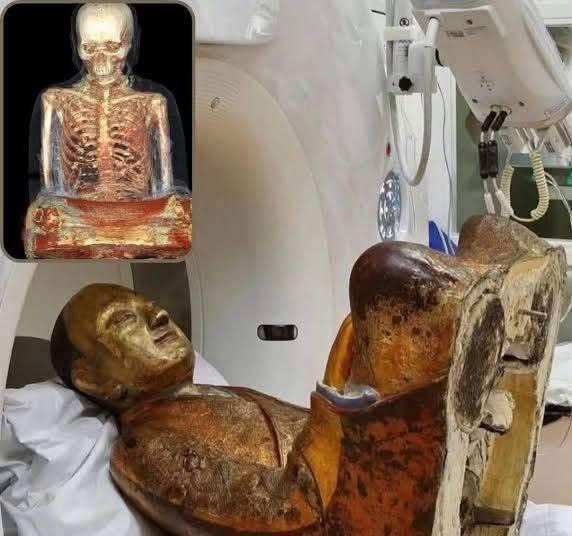
In March 2015, visitors to an exhibition in Hungary were surprised by a discovery that attracted worldwide attention. In front of them stood a Chinese Buddha statue over a thousand years old. Yet it was not the artistic beauty of this statue that made it famous, but what was hidden inside. A CT scan revealed that inside the statue was the mummified body of a monk, preserved in the lotus position for over a millennium. Instead of internal organs, many fragments of old Chinese paper were found. This discovery is considered one of the greatest archaeological mysteries of the 21st century.
Shortly after the revelation, villagers from a small town in China’s Fujian Province claimed that the statue had been stolen from their village 20 years earlier. It was believed that “Zhanggong Zushi,” a famous figure associated with healing and Buddhist teachings, had been enshrined in the statue. The statue had been housed in the village since the Song Dynasty in the 12th century. In December 1995, it disappeared without a trace.
In the years 2014–2015, the statue was exhibited in Europe and examined by Dutch researchers using state-of-the-art medical technology. The CT scan revealed the mummified remains of a monk in a meditation posture and internal organs replaced by inscribed ancient paper. Experts suspect that self-mummification, known in parts of Asia, was used by this monk, but they have not been able to confirm this definitively.
In 2015, the villagers of Yangchun recognized the statue on television. They compared old photographs and local documents with the statue on display in Europe. Chinese cultural authorities officially began an investigation and confirmed the identity of the statue as the stolen one.
A cross-border legal dispute followed, in which the villagers and Chinese authorities demanded the return of the statue. In 2020, a court in Fujian ruled in favor of restitution, but its implementation proved difficult. Due to international legal disputes, the statue remains in private ownership abroad to this day.
Interestingly, this Buddha statue is one of the few cases worldwide in which human remains have been found inside religious statues. The remains of old paper inside are of great interest to archaeologists because of possible ancient rites. Until 2026, the statue with the mummy inside remains one of China’s most famous unresolved restitution cases.